Aotearoa New Zealand is a beautiful country, no doubt about it.
Friendly people, clean water, clean air, beautiful mountains, lakes, and vistas. I’m proud and happy to call this my adopted home.
However, New Zealand has a small share market. As a percentage of the global share market, the NZX is about 0.1%. A rounding error. The NZ share market sits squarely between other tiny share markets of the world like Kuwait and Poland. Can you name a Kuwaiti company? How about 2 Polish companies?
The total market capitalization of the New Zealand Exchange (NZX) is about NZ$160 billion. This is about US$95 billion, or about the market cap of the 116th most valuable of the 500 most valuable American companies*.
You’ve probably never heard of it. The company is called Duke Energy and they are a power and electrical as well as natural gas company in 6 southeast states of the 50 US states.
This one company in America is more valuable than the entire NZ share market. And it’s not even a famous American company.
Here are the inflation-adjusted returns by country from 1900 to 2022.
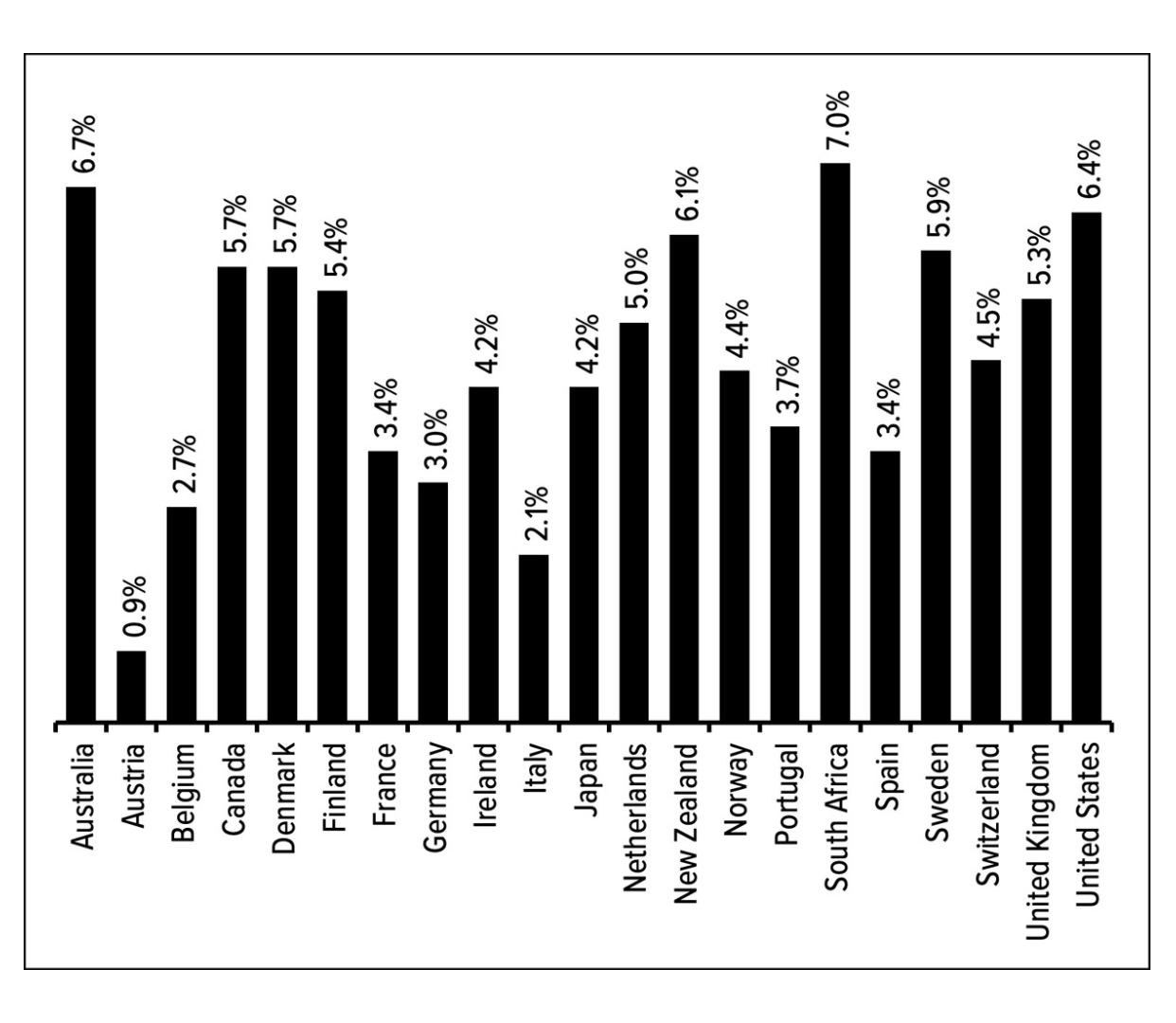
As you can see in the chart, if you were an Italian or Austrian investor and only invested in your home country, you had disappointing returns over those years, mainly due to wars and their after effects.
Most Kiwi investors have a large portion of their assets and life in New Zealand. For example, an average Kiwi investor might their home, job, bank accounts, family, and all material assets on this tiny rocky in the middle of the South Pacific.
If you can diversify some of your investments outside this country of 5 million humans and 25 million sheep, why wouldn’t you?
With the recent introduction of low-cost, total global share market funds like the Foundation Series Hedged Total World Fund, the average Kiwi investor can diversify into 10,000 companies around the globe. By spreading your risk, you’re guaranteed to underperform some investing strategies, but you are ensuring that you will never get wiped out by risks like over concentration in a single country.
*The list of the 500 largest American companies is known as the S&P 500, named after the Standard and Poor’s, a credit rating agency and index provider. They keep track of lists like the 500 largest companies in America.